Nouveaux riches
Koen KleijnArchitect Philips Vingboons (1607-1678) designed a row of four houses (Herengracht 364-370) for the Catholic timber merchant Jacob Cromhout (1608-1669) and his wife Margaretha Wuijtiers in 1660. Cromhout lived at number 366 and rented out the other three houses.
The four ‘Cromhout houses’ have stone façades that are decorated with triangular pediments. Natural stone is virtually non-existent in the Netherlands, which makes it quite unusual in the canal belt. The material used to construct the four façades must have come from Germany or Wallonia on a large barge, which would have been a costly affair. This sign of prosperity also highlighted the fact that the architect had the ambition to operate on an ‘international’ level by using something that was considered better than normal brick.
While the stone façades were already quite the statement, Cromhout really went all out with the interior design. His own house, Herengracht 366, which continues along number 368 on the side of the garden, is almost 17 metres wide. The room looks out on an enormous garden that continues to the Keizersgracht. The whole complex was designed from top to bottom by Vingboons, ‘with Italian fabrics and a French cut’. The message ‘prosperity with taste’ was propagated in everything from the curtains to the upholstery, the marble in the hallway, the stucco, the wood carvings on the banister, and even in the patterns of the flower beds in the garden.
"A completely new house on two double yards in style of 16th century French castles. Money was not a problem"
At the end of the 19th century the moral of outward soberness had changed quite a lot; the ‘nouveaux riches’ had made an appearance. Jacob Nienhuys (1836-1927), the owner of the Herengracht 380-382, was not an old Amsterdam aristocrat but a newcomer who had become very rich with the exploitation of tobacco plantations on Sumatra. Nienhuys commissioned architect Abraham Salm to build a completely new house on two double yards in quite an unusual style, that of the 16th century French castles along the Loire. Money was not a problem and Salm had the freedom to do what he wanted.
Nienhuys did not incorporate the Amsterdam of the past but was inspired by the New York home of Cornelius VanderBilt, a classic example of ‘new money’. The façade was richly decorated and the interior was even more stunning, and Nienhuys’ home was the first in the Netherlands to have electric lighting.
This city palace was unparalleled on the canal. It was a building that far exceeded its 17th century origins and marked the emergence of new ‘Indian’ money in the city.
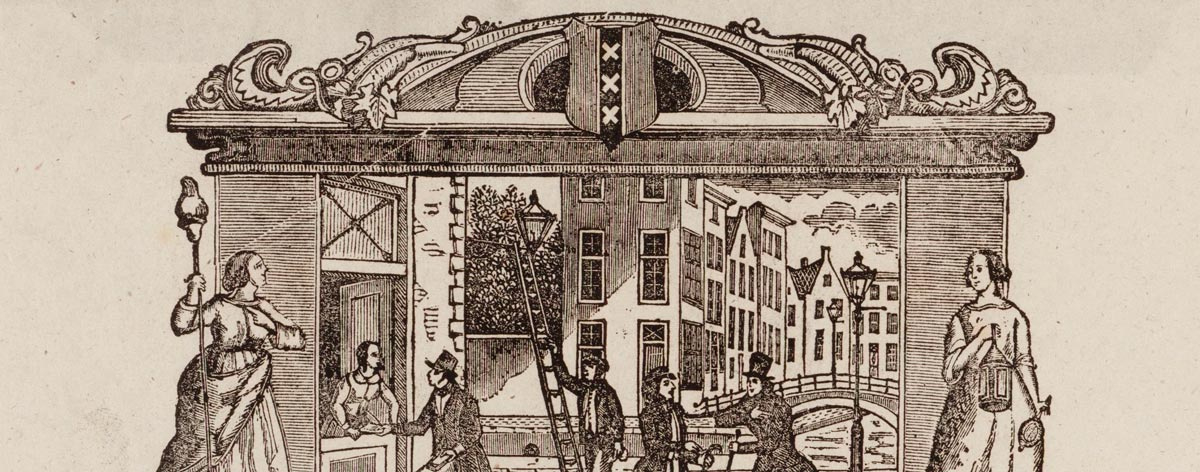
Photo: Anonymous, New Year greetings from lamplighter L. Kollewijn, 1852 (Collection Amsterdam City Archives)
This story origins in Edition #7 for which art historian Koen Kleijn went in search of ten remarkable city stories viewed from the theme 'The Medium is the Message'.

Koen Kleijn
Koen Kleijn is art historian, journalist, documentary filmmaker and writer. One of his specialties is the history of Amsterdam, on which he wrote several books. Since early 2018, he has been editor-in-chief of the historical monthly Ons Amsterdam. He is also regularly writes reviews for De Groene Amsterdammer, and is curator of Museum Het Grachtenhuis.