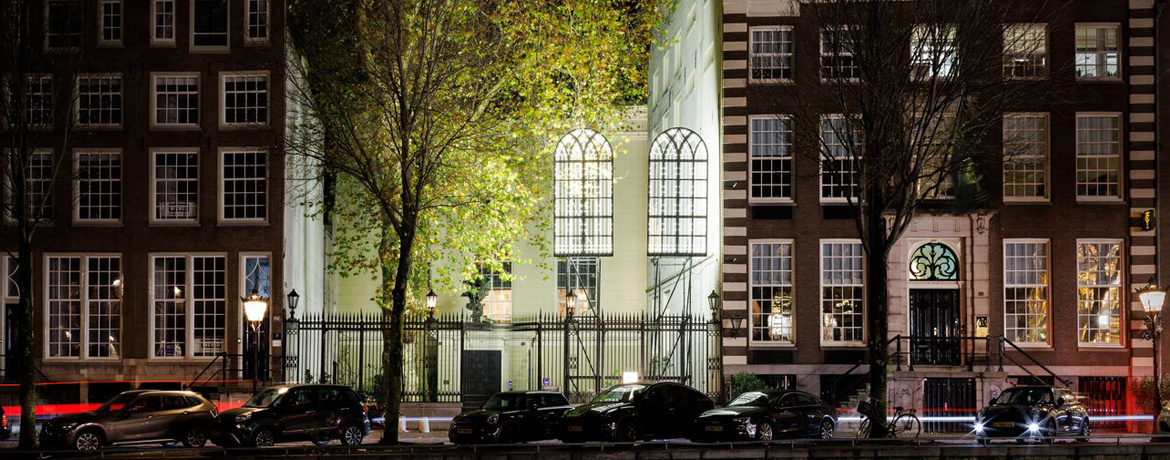

Quiet but powerful, Windows asks us to consider how freedom is shaped not only by law or policy, but by visibility.
Situated in the courtyard near the discreet façade of the 17th-century Singel Church, the work draws inspiration from the church’s glass windows – symbols of faith, sanctuary, and expression.
During the Dutch Golden Age, even in the relatively liberal Dutch Republic, religious freedom had its limits. Groups such as the Mennonites, though tolerated, were not permitted to openly practice their faith and instead worshipped in hidden 'shelter churches' (schuilkerken) like the Singel Church. From the outside, these buildings gave no indication of their spiritual purpose. Leegte’s intervention seeks to reverse that erasure.
Windows symbolically pulls the church out of hiding and into view. In doing so, the installation transforms the quiet courtyard into a site of reflection –both literally and figuratively– on the tension between visibility and concealment, acceptance and exclusion.
In a city built on openness and trade, the stories of those who had to remain hidden are often overlooked. Leegte's Windows stands as a beacon, not only of the Singel Church's enduring legacy, but of the broader human desire for belonging and the right to be seen.